

Cozy, warming recipe for these chilly autumn days.

The Conscious Mind
Thoughts & Musings
Studies have found that meals with high-protein content increase satiety. This delicious smoothie has got you covered with 25 grams of protein! The smoothie also contains rolled oats, which are low on the glycemic index. This will keep your blood sugar levels steady and leave you feeling energized until lunch.

Ingredients:
Recipe
+ LSA is a mixture of ground linseeds, sunflower seeds and almonds. Find it in the health food aisle of the supermarket. Tip: The bliss balls will keep refrigerated for 2–3 weeks.
Its aroma is irresistible. So many people cannot imagine starting a day without it. Is coffee flawless in its perfection? Like a modern-day beverage of the Gods... or should we consume it mindfully?
With less than 10 minutes preparation time this nourishing salad is ideal for the days, when it has to go quick and you don’t want to make big mess in the kitchen. Get all the autumn flavors in one dish!

Do you find it hard to make self care a part of your daily live? Sometimes it seems harder than it really is. When you are leading a busy life, self care is extra important. But when it becomes another thing on your to do list, it might give more stress than care.
The trick is to keep it simple, short and consistent. I will share my favourite and simple self care exercises with you:
Taking a 1 minute break to take 5 deep and slow breaths with your eyes closed is already a great way to take care of yourself and calm your nervous system. It can be dome any time, anywhere. Do this a few times a day and increase to 5 minutes of slow deep breathing if you have the time.
Take 10-15 minutes when you come home or just before you go to bed to lay down in a comfortable position, possibly making use of props, and relax in savasana or listen to a yoga nidra recording. This will help you release the activities of the day and sets the tone for a good night sleep.
Suze Retera teaches a Masterclass on a Saturday once a month, Slow Flow on Tuesday from 18:45-20:00 & Sunday from 10:30-12:00 and Vinyasa on Sunday from 9:00-10:15.

Ingredients:
FOR THE BURGERS:
FOR THE CILANTRO-LIME TAHINI SAUCE (makes 1/2 cup):
Recipe
Summer is hot, bright and sharp (pitta), and it boots most people’s energy levels and speeds up their metabolism. According to Ayurveda, the food that we put into our bodies affects our entire well-being, so it’s important to read up on our prakruti. Everyone has a specific balance of the three doshas.
Its aroma is irresistible. So many people cannot imagine starting a day without it. Is coffee flawless in its perfection? Like a modern-day beverage of the Gods... or should we consume it mindfully?
With less than 10 minutes preparation time this nourishing salad is ideal for the days, when it has to go quick and you don’t want to make big mess in the kitchen. Get all the autumn flavors in one dish!

They edit their own genes!
Just when we thought octopuses couldn't be any weirder, it turns out that they and their cephalopod brethren evolve differently from nearly every other organism on the planet.
In a surprising twist, scientists have discovered that octopuses, along with some squid and cuttlefish species, routinely edit their RNA (ribonucleic acid) sequences to adapt to their environment.
This is weird because that's really not how adaptations usually happen in multicellular animals. When an organism changes in some fundamental way, it typically starts with a genetic mutation - a change to the DNA.
Those genetic changes are then translated into action by DNA's molecular sidekick, RNA. You can think of DNA instructions as a recipe, while RNA is the chef that orchestrates the cooking in the kitchen of each cell, producing necessary proteins that keep the whole organism going.
But RNA doesn't just blindly execute instructions - occasionally it improvises with some of the ingredients, changing which proteins are produced in the cell in a rare process called RNA editing.
When such an edit happens, it can change how the proteins work, allowing the organism to fine-tune its genetic information without actually undergoing any genetic mutations. But most organisms don't really bother with this method, as it's messy and causes problems more often that solving them.
"The consensus among folks who study such things is Mother Nature gave RNA editing a try, found it wanting, and largely abandoned it," Anna Vlasits reports forWired.
But now it looks like cephalopods didn't get the memo.
In 2015, researchers discovered that the common squid has edited more than 60 percent of RNA in its nervous system. Those edits essentially changed its brain physiology, presumably to adapt to various temperature conditions in the ocean.
Now the team is back with an even more startling finding - at least two species of octopus and one cuttlefish do the same thing on a regular basis. To draw evolutionary comparisons, they also looked at a nautilus and a gastropod slug, and found their RNA-editing prowess to be lacking.
"This shows that high levels of RNA editing is not generally a molluscan thing; it's an invention of the coleoid cephalopods," says co-lead researcher, Joshua Rosenthal of the US Marine Biological Laboratory.
The researchers analysed hundreds of thousands of RNA recording sites in these animals, who belong to the coleoid subclass of cephalopods. They found that clever RNA editing was especially common in the coleoid nervous system.
"I wonder if it has to do with their extremely developed brains," geneticist Kazuko Nishikura from the US Wistar Institute, who wasn't involved in the study, told Ed Yong at The Atlantic.
It's true that coleoid cephalopods are exceptionally intelligent. There are countless riveting octopus escape artist stories out there, not to mention evidence of tool use, and that one eight-armed guy at a New Zealand aquarium who learned to photograph people. (Yes, really.)
So it's certainly a compelling hypothesis that octopus smarts might come from their unconventionally high reliance on RNA edits to keep the brain going.
"There is something fundamentally different going on in these cephalopods," says Rosenthal.
But it's not just that these animals are adept at fixing up their RNA as needed - the team found that this ability came with a distinct evolutionary tradeoff, which sets them apart from the rest of the animal world.
In terms of run-of-the-mill genomic evolution (the one that uses genetic mutations, as mentioned above), coleoids have been evolving really, really slowly. The researchers think that this has been a necessary sacrifice - if you find a mechanism that helps you survive, just keep using it.
"The conclusion here is that in order to maintain this flexibility to edit RNA, the coleoids have had to give up the ability to evolve in the surrounding regions - a lot," says Rosenthal.
As the next step, the team will now be developing genetic models of cephalopods so they can trace how and when this RNA editing kicks in.
"It could be something as simple as temperature changes or as complicated as experience, a form of memory," says Rosenthal.
The findings have been published in Cell.
Article comes from Science Alert
Sound and music are one of the most powerful tools in influencing our emotional state, and the vibrations of sound can be healing and destructive at the same time. Read more about the science behind sound here!
Why do we find the sounds of nature relaxing? Could it be that we carry the memory of things that are beneficial to us in our DNA? Hard to say but the science of sound might hold some clues.
Yes, you read that right, trees can glow! This may be the solution for a future where we rely less on electricity and unsustainable technology.
Japan has just invented Robo-bees that can legitimately pollinate the earth
There are many examples of the Divine Proportion found throughout the design of the universe and everything in it. But what do dogs, water and the fibonacci sequence have in common?
Unlike the encryption of today, quantum-based networks send messages inserted into particles of light.
The largest living organism in the world today is a honey fungus measuring 2.4 miles (3.8 km) across in the Blue Mountains in Oregon.

Pose: Anuloma Vuloma (or Alternate Nostril Breathing). A powerful pranayama to re-balance the energies in your body and start the week with a sharp focus!
The Right nostril is called Pingala Nadi (sun principle or the body) ,the left nostril represents Ida Nadi (moon principle or the mind). In alternate nostril breathing, one inhales through right and exhales through left, then inhales through left and exhales through right. This purifies the Ida and the Pingala Nadis. This purification brings balance to body and mind. Metabolic processes will be balanced.
The purpose of the Alternate Nostril Breathing is to balance the physical energy and the mental energy. It is recommended for all types of problems. As Hatha Yoga principle says that the health conditions are due to imbalance between this Ida and Pingala. Alternate Nostril Breathing balances this two forces.
Benefits of the exercise are:
Excellent breathing technique to calm and center the mind.
Our mind has a tendency to keep regretting or glorifying the past and getting anxious about the future. Nadi Shodhan pranayama helps to bring the mind back to the present moment.
Works therapeutically for most circulatory and respiratory problems.
Releases accumulated stress in the mind and body effectively and helps relax.
Helps harmonize the left and right hemispheres of the brain, which correlate to the logical and emotional sides of our personality.
Helps purify and balance the nadis - the subtle energy channels, thereby ensuring smooth flow of prana (life force) through the body.
Maintains body temperature.
Ramon Kinkel teaches Traditional Hatha Yoga every Monday from 18:30-19:45. You can also join him once a month from 20:00-21:45 at the special Yoga & Pranayama class.
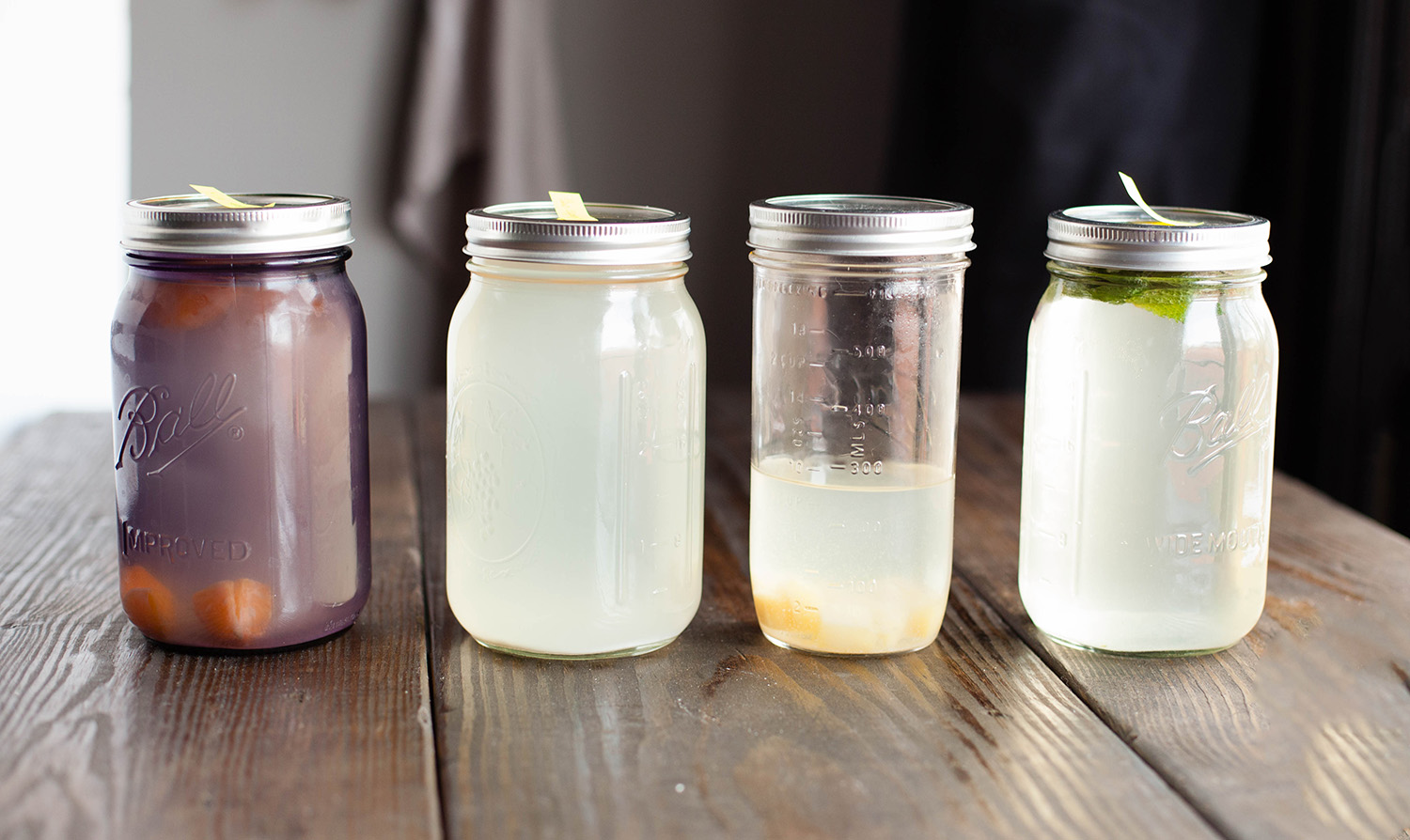
Water kefir is a light, naturally fermented, effervescent probiotic beverage with a diverse range of flavors and textures. Depending on how you prepare it, your water kefir can be sweet or sour with a texture ranging from light and sparkling to deep and yeasty.
It can even become a little bit alcoholic which may be of interest to some (around 0.5% or more depending on how long you ferment it and conditions).
Water kefir is made by mixing water kefir crystals or “grains” with water and sugar, and allowing the mixture time to ferment. These grains are actually Symbiotic Colonies Of Bacteria & Yeast (aka, SCOBYs), and come in the form of beautiful, translucent-jelly-crystals. In the right environmental conditions they can more than double in quantity every day!
Water kefir grains thrive on a mineral and carbohydrate-rich liquid diet. They can live in sugar water, fruit juices, coconut water, in soy/almond/rice milk, or even honey. Adding whole fruits to your kefir can give your SCOBYs a natural yeast boost, and enhance the flavor.
These little grains metabolize sugars into beneficial acids, releasing B vitamins and other healthy enzymes which aid digestion and nutrient absorption.
This video explains why a healthy gut is good for you.
When making water kefir, there are generally two phases of fermentation. During each phase, the probiotic concentration of your kefir increases and the sugars you have added decrease as they are consumed by the kefir cultures. Kefir fermentation is anaerobic, which means that no oxygen is required for your cultures to work their magic.

This is the first phase of fermentation, and takes place with your kefir grains present in the solution. During this phase, your ferment’s flavor and texture is heavily influenced by any fruits or roots present.
Fermentation proceeds at a faster rate, due to the large population of microorganisms (kefir grains) present.

This phase begins after the kefir grains are removed from your kefir. Your beverage will continue to ferment due to the invisible bacterial cultures still present.
Often additional sugar-source (i.e. syrups, fresh fruits, jam) is added during this phase and in a closed vessel or bottle so that carbonation can build.
First off, make sure you get WATER KEFIR grains. There is a difference between milk kefir and water kefir grains, and they are not interchangeable.
Next up, you’ll have to decide if you want powdered, dehydrated or live kefir grains.

Powdered Kefir Grains
Powdered kefir has unlimited shelf-life and is ready for immediate use. However, it generally isn’t able to reproduce for more than a few batches of kefir. You will have to keep buying more.

Dehydrated Kefir Grains
Dehydrated kefir grains have a nearly unlimited shelf-life, but you need to rehydrate them for a few days before you can use them. Once they’re out of “hibernation”, they will multiply indefinitely.

Hydrated / Live Kefir Grains
Live kefir grains are delivered in a sugar-water solution. They don’t live indefinitely without regular care, but they are ready for immediate use and will multiply, providing you with a lifetime supply of kefir grains.
If you’ve purchased dehydrated water kefir grains, you will need to “activate” (aka rehydrate) them first.
You will need:
1 tablespoon dehydrated water kefir grains
4 cups (1L) of boiled & warm water
½ cup (100G) of sugar (raw cane sugar, white refined sugar is fine, jaggery, coconut sugar, maple syrup, honey, agave syrup, rice syrup, barley malt)
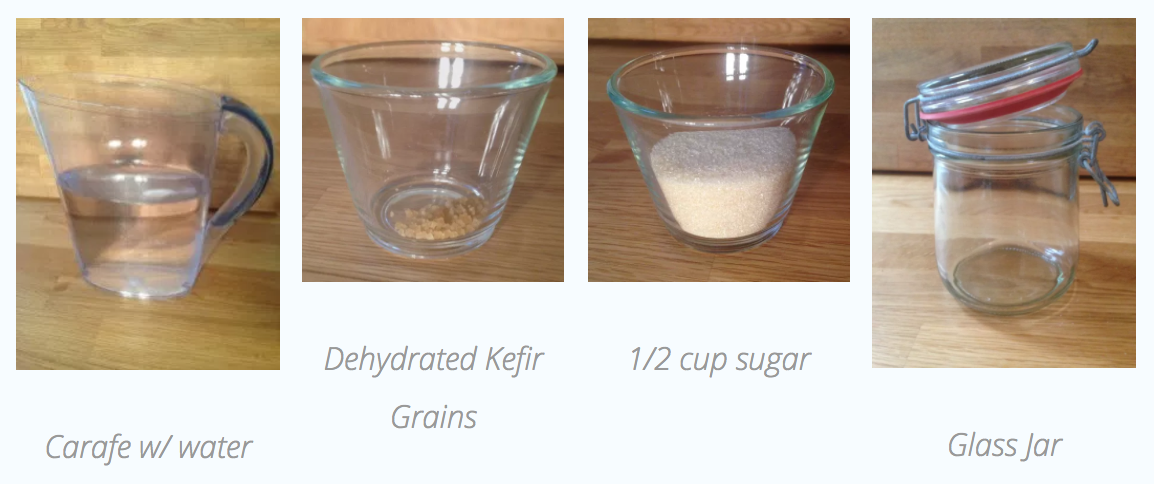
Instructions:
Now that you have your live, hydrated water kefir crystals, it’s time to make your first basic water kefir! (I'll be making one of my favorites - a refreshing fig-lemon-goji berry tonic.)
You will need:
1 tablespoon active (hydrated) water kefir grains
4 cups (1L) boiled & warm water
½ cup of sugar (raw cane sugar, white refined sugar is fine, jaggery, coconut sugar, maple syrup, honey, agave syrup, rice syrup, barley malt)
Dried or fresh fruits & roots for flavoring (for example: dried figs, cherries, lemon slices, apple slices, sarsaparilla, fresh ginger, goji berries, dates, etc)
(Optional) Flavored syrups, juices and extracts (lavender, vanilla, apple juice...)

Instructions:
1. Make your sugar solution. Add ½ cup (100g) of sugar to 4 cups (1L) of boiled, still warm water in a jar or plastic bottle. Stir till sugar is completely dissolved. Allow the sugar-water to cool to room temperature.
2. Add active kefir grains. Once the sugar water is completely cooled (again, hot water can kill your kefir!) add 1 tablespoon of active kefir grains.
NOTE: the more grains you have, the faster they digest available sugars, thus the faster your kefir will be ready. You may need to add more sugar and water.
3. Add dried and fresh fruits. The extra yeasts from the skin of the fruits help the fermentation process as your kefir grains eat the sugars and create more carbonation while adding fruity natural flavours.
4. Seal your container. Water kefir grains do not need oxygen to survive (like a kombucha SCOBY does), so your vessel can be sealed or lightly capped. The tighter the cap, the more carbonation builds up. I use a wide mouth jar so i can get fruit and the grains out and in more easily than a bottle neck
NOTE: over-carbonation can be dangerous, especially in glass containers! Open the cap every 1-2 days to release air-pressure and to avoid explosions.
5. Watch your ferment. After 48 hours, the fruit that sank to the bottom of your jar should now be floating at top. This means carbonation and fermentation are happening!
6. Pour the flavorful, effervescent liquid into a bottle while straining out the kefir grains.Place your grains in another sugar-water solution. These happy fellas have probably doubled in quantity, and are ready for your next ferment.
NOTE: You are what you eat, and your water kefir grains are no different. Expect them to change color according to the sweeteners, flavours and added ingredients you ferment them with. When you use hibiscus tea and honey to make a ferment it changes the grains pink!
7. The liquid product, now separated from the grains, is “Water Kefir’ and will continue to ferment and carbonate in the sealed bottle (secondary fermentation). This beverage can be cooled and enjoyed as is.
Optionally, you can enhance it further with herbs such as mint and cardamom, sweeteners such as sugar or honey, and various flavored syrups. You can even use it as a “starter” for other sodas & vegetable ferments, or instead of yeast for baking... the possibilities are limitless!
NOTE: Your final beverage will have MUCH fewer calories than your initial ferment. Water kefir feeds on sugars, digesting them and releasing CO2 (carbonation) in the process. Water kefir bacteria can eat maple syrup and agave syrup, unlike kombucha cultures. Sugar-free sweeteners such as stevia will NOT feed your kefir, but feel free to add it to your finished product for an low-calorie sweet taste!
Now that you have the basic recipe for making water kefir, it’s time to start experimenting!
Every water kefir has 3 variables:
Interested in reading more? This article was inspired by https://ediblealchemy.co/water-kefir/ Check it for further inspiration!
Summer is hot, bright and sharp (pitta), and it boots most people’s energy levels and speeds up their metabolism. According to Ayurveda, the food that we put into our bodies affects our entire well-being, so it’s important to read up on our prakruti. Everyone has a specific balance of the three doshas.
Its aroma is irresistible. So many people cannot imagine starting a day without it. Is coffee flawless in its perfection? Like a modern-day beverage of the Gods... or should we consume it mindfully?
With less than 10 minutes preparation time this nourishing salad is ideal for the days, when it has to go quick and you don’t want to make big mess in the kitchen. Get all the autumn flavors in one dish!










Summer is hot, bright and sharp (pitta), and it boots most people’s energy levels and speeds up their metabolism. According to Ayurveda, the food that we put into our bodies affects our entire well-being, so it’s important to read up on our prakruti. Everyone has a specific balance of the three doshas.